Sunday, March 17, 2019

Cheese South of the Border

When the Old World and New World collided in the 15thcentury, the conquistadors came to Central and South America with conquest, fame, and riches on their mind. However, after bringing disease and devastation to the indigenous population, the Europeans found themselves in a relatable situation: homesickness. In Alfred Crosby’s groundbreaking tome, The Columbian Exchange(1972), Crosby offered a new perspective on the first contact between Europeans and the New World, one that focused on the exchange of foods and agricultural goods between the Old and New World. While the Europeans brought crops like tomatoes, potatoes, peppers, maize, peanuts, bananas, coffee, and cacao back to the Old World, changing the foodways and culture, they also attempted to reproduce their own foodways in the New World. In particular, olive oil, wine, wheat bread, and cheese. The first colonizers in the Americas, the Spaniards and Portuguese, brought wheat seeds, cuttings of grape vines, olive tree rootstock, and lots of cows. Through trial and error, the Europeans eventually found firm footings for these staple crops and animals.

Cortés fights the Aztecs 1520
Cheese is a purely European introduction in Latin America. There were no large, domesticated animals in Latin America, except alpacas, which were purely used as pack animals. The indigenous populations in Latin America also were lactose intolerant, with adults losing their ability to digest lactose. Despite dairy being an introduced product to the Americas, it quickly became a cultural staple. While European settlers in the United States and Canada sought to replicate European cheeses precisely, taking their names and following their techniques, Latin Americans took inspiration from European cheeses and made them their own, evolving them for the climate and developing new flavors.

The plethora of cheeses throughout Central and South American countries is reflective of the country of origin of its colonizers, with a breath and diversity only matched by that of European countries. In Mexico, cheesemaking arrived with Spanish settlers. The first record of cheese dates from 1585 when a rancher named Diego Montemayor started producing a Manchego-style cheese (Yescas, 2016, 468). While slow to spread past the Spanish population, cheese eventually became a staple part of the cuisine, featured in traditional dishes like chile rellenos, quesadillas, frijoles, or used to thicken and flavor sauces or to garnish refried beans. Mexican cheeses are usually fresh and too numerous to name due to the regional, small scale on which they are produced. However, some of the most popular and interesting cheeses include Queso Qaxaca, Queso Cotija, and Chihuahua. 

Queso Qaxaca is a pulled curd cheese, similar to mozzarella, and originally from the town of Etla in the southern state of Oaxaca. Traditionally, cheesemakers pull the cheese into long strains that are then wound together in a ball, resulting in a cheese that looks like a ball of yarn (Yescas, 467). Queso Cotija is one of Mexico’s few aged cheeses. Dry, salty, and granular in texture, the cheese comes from the states of Jalisco and Michoac where it is made during the rainy season in the mountains and then brought down to the town to age. Similar to the Protected Designation of Origin (POD) status of many European cheeses, in 2005 the Mexican Government granted the Cotija a Collective Trademark, which requires that the cheese be produced only in these two states, each wheel weigh 49 pounds, be salted with Colima salt, and be aged for at least two months. However, despite the Collective Trademark, there are copies of the cheese marketed as Cotija from other parts of the country (Ibid). Chihuahua, named after the Mexican state from which it originates, stands out from other Mexican cheese as the techniques for making the cheese comes from Mennonite farmers rather than the Spanish (Sung, 2017). Made by the descendants of Swiss Anabaptists, who settled in the state during the 16th century, the cheese resembles a mild cheddar in taste and texture.
Queso Qaxaca. Source: Cremeria Romero

Argentina’s cheese culture has a heavy Italian influence, with cheese bearing diminutions of the names of Italian cheeses. Reggianito, or “Little Reggiano,” is the Argentine interpretation of Parmigiano Reggiano. Coming in smaller wheels and aged for a shorter period of time than Parmigiano, the cheese is the most exported cheese in Argentina, creating controversy as many foreign consumers mistake it for its Italian counterpart. The mix up is one of the many reasons Parmigiano Reggiano received PDO status. Another diminutive, Provoleta, is the Argentine spin on Italian Provolone. The cheese is similar in taste and texture to the original, but unlike the Italian provolone, Argentinians consume Provoleta by grilling it in small disks and pairing it with grilled meats and spicy sauces. Finally, Argentina’s answer to Italy’s sheep’s milk pecorino is Sardo, a cow’s milk cheese with a slightly salty taste and semi-hard texture (Ditaranto, 2014). 

In Brazil, cheese can be found at every meal, including dessert, and reflects the depth and variety of textures, tastes, and immigrant influences within the country. Two of the most popular cheeses, Catupiry and Queijo Minas, come from Minas Gerais, the Brazilian state with a large Italian immigrant population. Catupiry is a brand of cheese that falls under the category requeijão, a ricotta-like cheese with a flavor similar to Brie or Camembert. An Italian immigrant named Mario Silvestrini developed the cheese in 1911. Queijo Minas, named after Minas Gerais, has a texture similar to buffalo mozzarella and holds particularly great weight in Brazilan culture. In May 2008, the cheese was declared part of “Brazilian Immaterial Cultural Heritage,” and the cheese can be traced back to the Portuguese region of Serra de Estrella. Finally, Queijjo Coalho is a rubbery curd cheese, often prepackaged on skewers to be roasted. The cheese does not melt but rather browns and is a beach snack staple (Ditaranto, 2014). 
Como assar queijo coalho
Queijo Coalho grilled on skewers. Source: UM Como
Numerous other countries in Latin America also produce a variety of distinctive cheeses that are a central part of their cuisine, including Venezuela, Uruguay, and Honduras. However, for the purpose of this post, I am focusing on our closest southern neighbor, Mexico. In recent years, Mexican cheesemakers have suffered from three main barriers. First, the North American Free Trade Agreement (NAFTA) resulted in the Mexican dairy market being flooded by cheap dairy products from the U. S, including powdered milk and cheese. In 2008, Mexican dairy farmers took to the streets protesting the elimination of trade barriers that put their products in competition with U.S. subsidized dairy (Freidberg, 2009, 230-231). In addition to locking horns with the U.S. over the trade of dairy products, Mexico and Spain spar over Manchego. As a former Spanish colony, Mexican cheesemakers make a cow’s milk version of the Spanish staple sheep’s milk cheese. Spain claims that Manchego’s PDO status makes it illegal for Mexican cheesemakers to call their cheese Manchego (Agren & Jones, 2018). On the consumer side, industrial cheese has increasingly entered the market, but these cheeses tend to be adulterated and carry fillers that negatively impact their quality and artificially raise their weight. 

There were a number of cheeses I wanted to try making, but, due to lack of time, resources, and skill, I decided to tackle the most widespread, well-known, and versatile cheese in Mexico: Queso Fresco. Literally translated “fresh cheese,” Queso Fresco has a mild, slightly salty flavor and can be cut, crumbled, or melted on a variety of dishes. Making this cheese ended up being an adventure: I did not have quite the right culture (a mix of Mesophilic and Thermophilic rather than the called for Mesophilic) and my thermometer broke and said the ambient temperature was 90 degrees. I used the New England Cheesemaking recipe for Queso Fresco, which calls for keeping the milk at around 90 degrees constantly. After adding the culture and then the rennet, I tried to cut the curd to just over half an inch. I ended up cutting it too small, which causes the cheese to be drier. 
Draining curds in butter muslim
The cut curds are gradually heated again and stirred to induce the release of whey. Once the desired firmness is achieved, the curds are drained, salted, and then pressed. I ended up separating the curds into two cheeses, one like a traditional Queso Fresco and the other to be rubbed with salt and let to sit out and dry. 
 
My Queso Fresco with a salt rub
I’m excited to try more Latin American cheeses. The innovation and creativity displayed by Latin American cheesemakers produces delicious cheeses to be eaten alone or used as an ingredient. European colonization may have introduced cheese to Latin America, but Latin America made cheese its own.
Works Cited
Agren, D. & Jones, S. (2018 Jan 15). Cursed are the cheesemakers: Spain and Mexico locked in manchego dispute. The Guardian. Retrieved from https://www.theguardian.com/world/2018/jan/15/spain-mexico-trade-deal-manchego-cheese-dispute.

Ditaranto, J. (2014a Nov 4). Latin American cheese: Brazil. The World of Cheese Culture. Retrieved from https://culturecheesemag.com/blog/latin-american-cheese-brazil.

------. (2014b Nov 11). Latin American cheese: Argentina. The World of Cheese Culture. Retrieved from https://culturecheesemag.com/blog/latin-american-cheese-argentina.

Sung, E. (2017 Jan 31). A guide to buying Mexican cheeses. Epicurious. Retrieved from https://www.epicurious.com/holidays-events/get-to-know-your-basic-mexican-cheeses-article.

Yescas, C. (2016). “Mexican Cheeses.” By Donnelly, C., The Oxford Companion to Cheese. New York City: Oxford University Press.

Saturday, February 23, 2019

Spreading the Word About Butter!

I have a fascination with all things petrified. Fossilized dinosaurs, mammoths, mummies in ancient Egypt, Bog Bodies in Northern Europe, Otzi frozen in the Alps, the bodies in Pompeii, I could go on forever! These petrified remains of people, animals, and plants are not only biologically cool, but they are also a snapshot in time. A paused movie with the characters suspended in their last actions. But of all these petrified remains, one of my favorites is bog butter. Between the Iron Age and medieval times, ancient Celtic people would bury butter in the local bogs. The bogs, made of peat and with a cool, low-oxygen, high acid environment, served as a source of natural refrigeration. Like a refrigerator, archeologists believe the Celtics hid their butter in bogs as either a form of preservation or as religious offerings. Butter was a valuable commodity at the time both in terms of nourishment and as a form of exchange, so it made sense to save butter for hard times and to hide it from thieves (Daley, 2016).

Bog Butter at the Cork Butter Museum a must see for butter and food enthusiasts alike, Cork, Ireland. Photo by Rachel Snyder
Today the butter we buy in stores tastes very different from these preserved lumps found in bogs (bog butter would have been very pungent like an aged cheese). However, little has changed in how butter is made and how humans consume and place cultural meaning to the yellow spread.
Butter is made from heavy cream from the milk of ruminants (i.e. cows, goats, sheep, yak, buffalo, etc.). Heavy cream is able to become butter because it is an emulsion. An emulsion is when one substance is suspended in another substance in tiny globules. These two substances never mix. The emulsion that makes up heavy cream is water with globules of fat suspended and surrounded by a membrane of phospholipids and proteins. In the butter making process, these globules are slammed against each other, causing them to stick together until they form a lump of butter. The remaining liquid is the buttermilk. The buttermilk sold in grocery stores is different from this residual liquid, as it is only milk that has been soured from the addition of an acid (Oklahoma Cooperative Extension, n.d.).
milktobutter
The emulsion in milk vs butter. Source: https://scienceandfooducla.wordpress.com/2013/05/28/homemade-butter/

While there is a debate as to whether cheese came before butter, anthropologists largely agree that butter production started in the Neolithic when the first Stone Age ancestors succeeded in domesticating ruminants. The theory is that a prehistoric shepherd accidently discovered butter when, upon placing butter in a sack made from animal skin and traversing over a bumpy route for hours, the rhythmic movement of his trek generated solid lumps in an opaque liquid (Khosrova, 2017, 267). The taste of these lumps must have appealed to the theoretical prehistoric shepherd, as butter making spread throughout the Middle East, Indus Valley, Africa and eventually to Europe. 
Since that fateful shepherd, butter has taken on special culinary and cultural significance. The first written evidence of butter comes from 4,500-year-old limestone tablets detailing the butter-making process. Ancient Sumerians offered butter to the fertility goddess Inanna, protector of the seasons and harvest. Indian Hindus have made offerings of ghee, clarified butter or butter oil, to Lord Krishna for over 3,000 years. Ancient Romans associated butter with barbarism, but they, along with Ancient Egyptians and Greeks, also used it medicinally and cosmetically, applying it to their hair and skin (Jankowski, 2017). In addition to bog butter, Scandinavian and other Northern European peasants used butter as a form of tender to pay their taxes to the lord. 
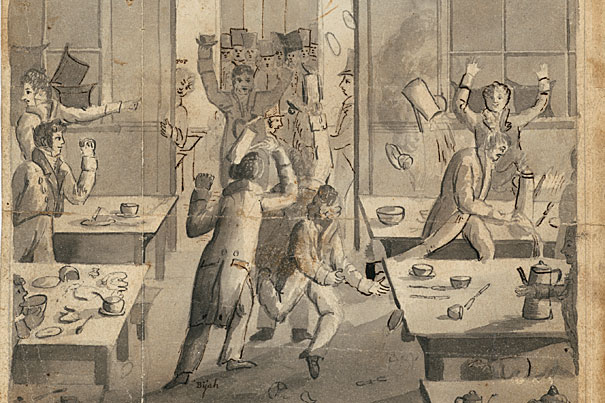
Butter came to the United States with European colonists, who brought their dairy cows with them. Soon after their arrival, the colonists replicated butter’s cultural importance in their new home. The first student protests in the U.S. were over butter. Harvard University’s Great Butter Rebellion of 1766 started in response to students being served rancid butter in the dining hall (Jankowski, 2017). While butter’s long standing rivalry with margarine and the recent heath fads denouncing fats in general and butter in particular have resulted in decreased consumption of butter in the U.S. and Europe, it still remains an essential part of the culture and cuisine of people around the world.

Harvard’s era of dissent began with the “Great Butter Rebellion” of 1766. It was the first known student protest on an American campus and for a time led to half the student body being suspended.
Harvard University's Great Butter Rebellion of 1766 occurred after the students, suffering from the abominable dining hall food, finally had enough when they were served rancid butter. Source:https://news.harvard.edu/gazette/story/2012/04/harvards-long-ago-student-risings/.

Those cultures and butter’s manifestations within them are more diverse than you would think. In the U.S. we associate butter with European culture. We conjure images of angelic milkmaids, pastoral vistas of docile cows grazing, and the wholesome combination of bread and butter, simultaneously symbolizing abundance, purity, and humility. Thus, we tend to associate butter with Europe and her colonies. However, butter production started in the Middle East and Africa, and it never left. 

Related image
Despite our association of cows with butter, the first butter would have probably come from goats, sheep, or camel milk, and in many countries in Africa camel milk is still the main source of dairy products. Source: https://www.reuters.com/article/us-mauritania-camels/camel-milk-put-it-on-your-face-as-well-as-drink-it-idUSL0372229420070403.
Africa’s dairy countries run from just south of the Sahara east to the Horn of Africa (i.e. Ethiopia, Uganda, Somalia, and Kenya), down the eastern highlands and into the south (Abdelgadir el al, 1998, 2). Due to the warmer climate, butter in Africa is usually made from soured or fermented milk, and, to increase its shelf life, it is typically cooked and churned into a butter oil or ghee. In the Sahara, for Tuareg nomads of the Ahaggar (Algerian Sahara) milk remains a staple food and butter is made from camel milk. To increase its shelf life, the butter is made into a strained butter oil similar to ghee (Khosrova, 28). In Uganda, the cattle corridor which, stretches from the Southwest to the Northeast, is home to the cattle-herding Bantu and Nilotic who still practice traditional ghee production (Wasswa el at, 2017, 11759). Based on archaeological evidence, Sudan’s cattle culture stretches back at least 5,000 years, compared to only 4,000 years north of the country in Nubia and southern Egypt. Archaeologists have found skulls of cattle ceremonially placed in human graves, and, among the Jebel Moya in central Sudan, people had burial grounds for their cattle. Later civilizations in the area are characterized by their rock drawings and pottery featuring cattle and vessels filled with milk. The classical Greek writer Strabo (7 BC) even mentioned the people of the area, Meroites (called Ethiopians by classic writers), as eating cheese and butter (Abdelgadir, 1). Today, milk and milk products remain an essential part of the diet and lifestyle of nomadic tribes throughout the country. 

Image result for map of africa
The African Continent. Source: https://www.researchgate.net/figure/Africa-Map-Maps-of-World-2014_fig1_319459630.
My interest in butter in Africa sprung from the discovery of smen, Moroccan fermented butter. While Morocco is not apart of the main dairy cultures in Africa, smen serves a significant cultural role in Moroccan cuisine. Smen, similar to ghee in other parts of Africa and India, is fermented as a means to increase butter’s shelf life (and flavor). The acidity that forms from fermentation protects the butter from bad bacteria, but it also gives the butter a funky, cheesy aroma. The butter is used in cooking, especially couscous, spread on bread, and even put in coffee. Being energy dense and filling, it is also used extensively during Ramadan. Smen has been described as being like a fine wine that gets better with age, so the longer smen ages the more expensive and the smoother the texture. A legend attached to smen is that Berber tribesmen would bury a clay jar of smen on the day of their daughter’s birth and unearth it to use to prepare her wedding day feast (Schmidt, 2014).

Image result for smen
Like most products that were once produced at home or sourced locally, smen is now mass produced and available in grocery stores. Source: https://www.zamourispices.com/smen-p/smen.htm.
When I asked my friend Mouna from Morocco about smen, her first response was that it “smells bad” and her grandmother likes it. Smen is obviously an acquired taste, one that the younger generation is not keen on. However, fascinated, I decided to make my own smen. First I made butter by taking heavy cream and agitating it. I tried two methods, the jar and the stand mixer. While the jar method is great for getting kids to expend some of their energy, the mixer is much faster and a lot less arm work. If you have some unsalted butter on hand, you can just use that as well. After making the butter, make oregano tea (discarding the dried oregano leaves), and once that cools, message the tea and salt into the butter. Then place in an airtight jar and store in a cool space. You can always bury you jar or clay pot in the ground if you are feeling y, but a cupboard will do fine. Now let it sit for at least a month. The longer it sits, the funkier the favor. Check back to see how my smen turns out. 

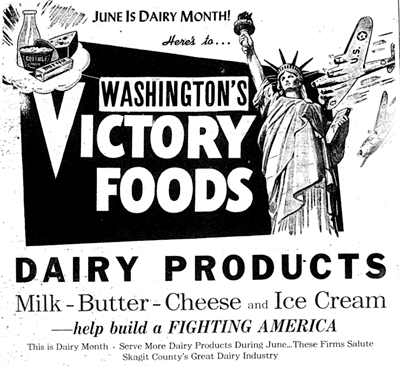
WWII propaganda promoting the consumption of dairy products. Source: https://www.skagitcounty.net/Departments/HistoricalSociety/ww2ads/26.htm.
During World War II, a common mantra was that the U.S. would win the war with “bombs and butter,” signifying the importance of the yellow spread in American and European culture and identity. However, the culture of butter and dairy goes beyond the confines of Europe and the dominance of the cow. Even in places with no PDO cheeses or large herds of black and white Holsteins or doe-eyed Jerseys, dairy is still a staple of the diet and a defining part of the history and culture. Today these dairy products are even more important to the nutrition of the region. According to the Director General of the International Food Policy Research Institute (IFPRI), Shenggen Fan, the promotion of dairy and other livestock products in famine-prone African nations like Ethiopia is essential to tackling issues of malnutrition (2019). Furthermore, as the main producers of these products, promoting their production also serves as a means to increase the economic and social status of women in these countries. Next time you slather butter on your morning toast, remember that you are part of a larger, more extensive, and older culture of people who love butter.  
Works Cited

Abdelgadir, W. S., Ahmed, T. K., & Dirar, H. A. (1998). The traditional fermented milk products of the Sudan. International Journal of Food Microbiology, 44, 1-13

Daley, J. (2016 Jun 13). A brief history of bog butter. Smithsonian.Retrieved from https://www.smithsonianmag.com/smart-news/a-brief-history-of-bog-butter-180959384/.

Fan, S. (2019 Jan 25). Healthy diets and sustainable food systems for all: A differentiated approach for animal-sources foods (ASFs). IFPRI Blog. Retrieved from https://www.ifpri.org/blog/healthy-diets-and-sustainable-food-systems-all-differentiated-approach-animal-sourced-foods.
Jankowski, N. (2017 Feb 24). Spread the word: Butter has an epic backstory. NPR The Salt. Retrieved from https://www.npr.org/sections/thesalt/2017/02/24/515422661/spread-the-word-butter-has-an-epic-backstory.

Khosrova, E. (2017). Butter: A Rich History. Chapel Hill, NC: Algonquin Books.

Oklahoma Cooperative Extension. (n.d.). The chemistry of butter. Ag in the Classroom. Retrieved from http://aitc.okstate.edu/lessons/dairy/butter.pdf.

Schmidt, A. (2014 Oct 9). Smen is Morocco’s funky fermented butter that lasts for years. NPR The Salt. Retrieved from https://www.npr.org/sections/thesalt/2014/10/09/353510171/smen-is-moroccos-funky-fermented-butter-that-lasts-for-years.

Wasswa, J., Sempiira, E. J., Mugisa, D. J., Muyanja, C., & Kisaalita, W. S. (2017). Quality assessment of butter produced using traditional and mechanized churning methods. African Journal of Food, Agricultire, Nutrition and Development, 17(1): 11757-11770.


Friday, February 8, 2019

A Tale of Two Cheeses: Monasticism and Its Contribution to Europe’s Great Cheeses


The monks left. So begins the tale of two cheeses, Époisses and Port Salut. Combined, these cheeses tell the true story behind European cheesemaking. While these cheeses are different in terms of taste and production, their history and evolution reveal the forces that have created some of the world’s most beloved and iconic cheeses as well as the issues and debates that characterize European cheesemaking today. Filled with religious fervor, peasant-master relationships, conspiracy and violence, alcohol, terrior, and the implications of mass production, the stories of Port Salut and Époisses provide a lens from which to view European cheeses that generate questions of production, labor, and consumption.

Cheesemaking and the Monastery
            Époisses and Port Salut are both apart a long tradition of monastic cheesemaking. In response to the incursion of Frankish tribes and Irish monastic missionaries compromising the power of the Roman Catholic Church, Pope Gregory I endorsed the establishment of Benedictine monasteries. The original intent of the Benedictine Order was a dedication to education and learning, public service, social responsibility, and self-sufficiency (Kindstedt, 2012, 123). Monastic cheesemaking goes back to at least the ninth century. A compilation of monastic managerial directives called The Customs of Corbie describes how the monks made cheese from its own flock of sheep as well as received cheese in the form of tithes (tribute) through manors and villas under their administration, known as the manorial system (Ibid, 131). Additionally, a ninth century biography of Charlemagne (Charles the Great), describes Charlemagne’s affinity for a cheese from the monastery of Saint Gall. According to the biographer, Charlemagne liked the cheese so much he asked for two cart loads to be sent to him every year (Ibid., 132). 
Source: Making White Cheese During the Middle Ages (From Tacuinum Sanitatis (ÖNB Codex Vindobonensis, series nova 2644), c. 1370-1400)
            The cheeses made by the monks or the peasants paying them tithes were soft-ripen cheeses, either bloomy rind or washed rind cheeses. These cheeses would be made from pooled milk, resulting in a higher acid level. The resulting curds were higher in moisture and, after pressing, were soaked in a brine bath. The defining part of these cheeses was the curing process. An orange mold would be cultivated on the outside of the cheeses through periodic washings in either a weak brine or alcohol, usually also made by the monks (Ditaranto, 2014). Each monastery had its own unique recipe that reflected, among other factors, the bacterial cultures of the area, the animals raised, the moisture and acidity levels, the washing solution (alcohol or otherwise), the temperature and humidity during storage, and the length of time the cheeses aged. 
The History of Epoisses 
Époisses is one of the softer cheeses developed in monasteries. Some sources date its production back to the seventeenth century, while others place it in the sixteenth century. Regardless of its first production date, we do know production started at L’Abbaye de Citeaux where the Cistercian monks made the cheese for almost two hundred years (Roman, 2015). 
And then the monks left…
The records do not say why or exactly when the monks left, but before they went they made sure to teach the local peasants how to produce Epoisses. The cheese grew in popularity throughout France. Reportedly, it was Napoleon’s favorite, and France’s most famous gourmands, the politician, philosopher, and all-round foodie Jean Anthelme Brillat-Savarin (1755-1826) crowned Epoisses “the king of cheese” (Ibid). 
Epoisses with its signature orange rind and pudding-like texture. Source: Murray's Cheese


However, this cheese almost disappeared from the French cheeseboard. The method for production was traditionally orally passed down from mother to daughter. However, during both World Wars, with men off at war women had to take care of all aspects of running the farm, leaving very little time for cheesemaking (Risoud, 2016, 254). The cheese might have been lost forever if it was not for two local farmers, Robert and Simone Berthaut, who obtained the recipe from a few local old women who still remembered how to make the cheese (Roman, 2015). In 1956 they started producing the cheese again. By 1991 the cheese received AOC status, and in 1996 it received PDO (Protected Designation of Origin) protection. Since 2015, 1,400 tons of Epoisses are produced annually (Risoud, 254).
A defining feature of Époisses’s production is the use of marc de Bourgogne, a brandy produced locally in Burgundy, to wash the rind while the cheese ages (Roman, 2015). The process reflects the close ties between the production of alcoholic beverages, like beer, wine, mead, and cider, with monasteries. The Cistercian monks who started the recipe would have most likely made their own brandy or wine and used it to wash the outside of the cheese. 
            Within the cheese world, AOC and PDO production has become a contentious subject. France claims it preserves cultural heritage and economically supports small producers. However, countries that received large numbers of European immigrants, such as the United States, claim these cheeses are part of the cultural heritage of the immigrants that settled in their country, as they brought the knowledge of the methods of production with them and then replicated them (Rowan, 2018). 
The History of Port Salut
             And the monks left…
So begins the story of another monastic cheese. Port Salut is a relatively new cheese in comparison to other monastic cheeses, but its history is still illustrative of the forces behind the production of most European cheeses. In the late eighteenth century, a monastery of Trappist monks fled France due to the French Revolution that resulted in France’s Catholic monarchy being disposed. They found refuge in the Alps where they learned how to make Gruyere cheese (Blume, 2011). 
Upon returning to France in 1815, the monks set up a new monastery in Entrammes, called Notre Dame du Port du Salut (Ibid). The monks started raising cows and making a washed rind cheese that was a softer version of Gruyere. In 1873 they began distributing “Port du Salut” in Paris (Hillerbrand, 2013). The cheese’s popularity spread out of France. The recipe traveled across Europe to Eastern Europe as well as across the Atlantic to North America (Ditaranto, 2014). The abbey continued to produce the cheese until 1959 when the monks of Notre Dame du Port du Salut sold all rights to making the cheese to a large dairy corporation, the Société Anonyme des Fermiers Réunis (SAFR) (or the limited corporate partnership of united farmers) (Blume, 2011). 
Port Salut's signature orange washed rind has been replaced in recent years with a cloth rind. Source: Cooks Info
Due to the cheese’s popularity, the monks trademarked the name “Port Salut” at the end of the 19thcentury. Imitators started going by the name St. Paulin (Blume, 2011). Despite the trademark, some small farmhouse producers still make cheeses labeled with the name Port du Salut or Port Salut. There are also British and Canadian Port Saluts and a Danish Port Salut. Mass production has taken its toll on Port Salut; the cheese has lost its washed rind, punchy aroma, and tangy flavor (Blume, 2011). Thus, unlike Epoisses where popularity generated protection of heritage and quality, popularity has led Port Salut to fall in quality and shirk aspects of its original production.
Two cheeses, both started in the monastery, yet they end on either side of the spectrum of cheese production today. One has retained its heritage and quality though at the expense of placing its production under regulatory control and distribution. The other has managed to expand its production, but along the way it lost touch with its origins. The monks may have left the cheese room for both of these cheeses, but, despite the changes these cheeses have weathered, they continue the legacy of these early cheesemakers.
Epilogue
            The story of monastic cheese does not end here. Monasteries around the world still produce cheese as a means of supporting themselves. Examples include Our Lady of the Holy Angels in Crozet, VA., Abbey of St. Benoit du Luc in Quebec, and in Bangalore, India at the monastery of Benedictine monks of the Vallombrosian Order. Inspired by the monastic history of cheese, I decided to make my own cheese in the same style of a monastic cheese. When I started my graduate degree at Chatham University, I lived in Orchard Hall, the residence hall on their Eden Hall campus dedicated to the Falk School of Sustainability. The campus felt so isolated from Pittsburgh, it became a joke among residents that we lived in a monastery. My goal: to create a monastic style cheese reflecting the terriorof Eden Hall. Check back later to see what I come up with.   

Blume, a. (2011 Oct. 4). Popular French cheese isn’t what it once was. Evansville Courier & Press.Accessed from http://archive.courierpress.com/features/popular-french-cheese-isnt-what-it-once-was-ep-445063131-324685711.html/.

Ditaranto, J. (2014 Sept 20). Cheese devotees: All about monastic cheeses. Culture: The World of Cheese. Accessed from https://culturecheesemag.com/cheese-bites/cheese-devotees-monastic-cheeses.

Hillerbrand, M. (2013 Mar 1). Homemade Port Salut cheese. Culture: The World of Cheese. Accessed from https://culturecheesemag.com/diy/homemade-port-salut-cheese.

Kindstedt, P. (2012). Cheese and Culture: A History of Cheese ad Its Place in Western Civilization. White River Junction, VT: Chelsea Green Publishing.

Risoud, G. (2016). Époisses. By Donnelly, C., The Oxford Companion to Cheese. New York City: Oxford University Press.

Roman, G. (2015 Mar 13). Bon Fromage: Epoisses, the creamy king. Culture: The World of Cheese. Accessed from https://culturecheesemag.com/blog/bon-fromage-epoisses-the-creamy-king.

Rowan, J. The EU doesn’t want your Parmesan cheese. The Food Institute. Accessed from https://foodinstitute.com/blog/eu-doesnt-want-your-parmesan-cheese.

Saturday, January 26, 2019

The Cradle of Dairy Consumption: Dairy in the Middle East

Let’s start with the basics. Who figured out that heating up milk and effectively curdling or souring it could preserve milk? To answer this question, we must go to Mesopotamia, the “Cradle of Civilization.” For the first stop on our dairy adventure around the world, we are going to the Middle East! 

For the purposes of this research, I have defined the Middle East as comprising Turkey, Cyprus, Syria, Lebanon, Iraq, Iran, Israel, the West Bank, the Gaza Strip, Jordan, Egypt, Saudi Arabia, Kuwait, Yemen, Oman, Bahrain, Qatar, UAE, Afghanistan, and Pakistan. Some definitions also include Greece or the Northern African countries Tunisia, Algeria, and Morocco. Afghanistan and Pakistan are also often left out, but I have decided to include them due to geographic and cultural similarities.

Source: The Jerusalem Post


Mesopotamia is located in present day Iraq, Syria, Saudi Arabia and parts of Turkey in the watershed of the Tigris and Euphrates rivers. It is here that archeologists have found the earliest evidence of the consumption of dairy products. Carbon isotope analysis of pottery sherds indicates that dairy products have been consumed in the Middle East up to 4,000 years ago (Scharfman, 473). Additionally the earliest written records, including cuneiform tablets from 3100 to 3000 B.C. and the earliest sources from the Sumerians, Babylonians, and Hebrews, reveal that milk was rarely consumed in its raw liquid form but rather soured and turned into butter (clarified for longevity), cheese, and dried buttermilk balls, or milk cakes. Milk cakes probably served as a form of instant milk, and archeologists have unearthed petrified chunks with holes in them in the Middle East, suggesting they were strung and hung to dry. These cheeses’ modern manifestations include bagel in Kuwait and a cheese called Kisk found throughout the Middle East (Valenze, 2011, 30). 

3,300-Year Old Cheese found in Saqqara, Egypt Tomb. Source: Archeology.com 

Though not consumed raw, milk, and the animals, specifically cows, from which it derives, served religious purposes for ancient civilizations in the Middle East. The Egyptian goddess Isis was the most powerful deity and embodied milk’s association life’s sustenance. As the “giver of life,” Isis championed mothers, matrons, and midwives in their jobs of sustaining life. In religious ceremonies and festivals to her and her husband Osiris, jars of milk served as offerings (Valenza, 15). From Egypt, Isis and her association with milk spread across the Middle East, resurfacing as Ishtar, the “benevolent cow,” in Mesopotamia; Hathor, the cow goddess in Egyptian Iconography; and the Virgin Mary in Christianity (Ibid, 17). 

The purpose of making dairy products like cheese and yogurt is highly practical: it takes a highly perishable substance, milk, and extends its life; removes some of the lactose from milk, making it more digestible for a lactose intolerant population; and served as an important source of protein. In the Middle East, cheese was usually made with sheep milk and boiled before being salted to kill off any bacteria. Yogurt or kefir would be made with goat milk. 

Dairy consumption is on the rise in the Middle East. Cypatriots have trademarked “Halloumi,” a boiled cheese that can be grilled or fried, exporting it around the world (Scharfman, 474). Rising incomes in oil producing countries has trebled imports of dairy products, and governments have built integrated supply chains with large dairy farms, such as Almarai, a Saudi farm founded in 1977. European companies, seeing a market opportunity, have invested in dairy companies, including Juhayne, the largest Egyptian dairy. Of particular interest for these European companies is the already established tradition in the Middle East of eating cheese and yogurt, offering a market for the US and Europe to dump their surplus (Terazono, 2015). However, low oil prices and civil unrest make the Middle Eastern market unstable, and there is still a strong tradition of making cheeses and yogurt at home.

With the above history in mind, I set out to make my own Middle Eastern dairy products. As this is my first time, I chose to make a fresh cheese, paneer, and a strained yogurt called labneh. 

Paneer, most commonly associated with Northern Indian cuisine, is a product of trade and invasion. The earliest reference to a cheese similar to contemporary paneer appeared around A.D. 75-300 and described a sold mass made from heated milk and curd. It is believed Afghan and Iranian invaders introduced paneer to Pakistan and India around the 13thor 14thcentury, which is supported by its similarity to cheeses found among Afghan and Iranian nomads and tribal peoples (Kumar, Rai, Niranjan, & Bhat, 2014). Paneer can be made with buffalo or cows milk and is fairly easy to make, with a firm texture and milky, bland taste that absorbs flavors well. 


To make my own paneer, I heated 1.5 gallons of milk to approximately 180°F, cooled to 170°F, and then added my acid, in this case ¾ cup lemon juice. The curds and whey almost immediately separated. 

I then drained the curds in a colander lined with butter muslin. 


Finally, I pressed the cheese with a makeshift cheese press. I did add a pinch of salt to my paneer. While this is not usually done, other fresh cheeses in the Middle East, like Ackawi, add liberal amounts of salt to their curds. The result? My paneer was a bit crumbly, possibly from draining it too long, but I might try placing my pressed cheese in cold water to firm it up. Paneer can be fried, grilled, or used a meat substitute in soups, stews, or curries. 


Next up was labneh. While just as simple as paneer, making labneh takes multiple days if you are making it from scratch. Yogurt is known by different names across the world, such as dahiin India, zabadi in Egypt, mast in Iran, leben raibin Saudi Arabia, and laban in Iraq and Lebanon (Fisberg, Machado, 2015, 4). It is believed the word “yogurt” comes from the Turkish word “yoğurmak,” which means to thicken, coagulate, or curdle. Texts from the 11thcentury in Turkey describe its use by nomadic Turks, and scholars believe Genghis Khan, founder of the Mongol Empire, fed his army yogurt (Ibid, 5). Labneh is a staple throughout the Middle East and is traditionally made at home. However, like in many places, people are increasingly switching to store bought. 

For my yogurt I heated a gallon of milk to approximately 185°F, and then quickly cooled it down to 115°F. The wonderful thing about yogurt is that it makes itself. Once at 115°F I added ¾ cup of plain yogurt. The microbes in the yogurt will multiple in the warm, curdled milk, thickening it into a spoon-able consistency. I then quickly wrapped the bowl in aluminum foil and my flannel jacket to incubate the yogurt overnight. The next day, I had yogurt! But for it to become labneh, I then had to strain out the liquid. Mixing with salt and a little lemon juice, I placed the yogurt in a cheesecloth bag and hung it from the facet to drain overnight. The longer it drains, the firmer the yogurt. Finally, I shaped the yogurt into balls, rolled them in Za’tar, a traditional Middle Eastern spice blend, and placed in a container with olive oil. Labneh can be used as a dip or spread.


There are so many more delicious dairy products in the Middle East, including kefir, a fermented yogurt product, and a variety of cheeses. I am excited to try making more of these products, the vestiges of the first civilizations’ dairy products.

If you are interested in making paneer or yogurt, I used the following recipes as guides:
Paneer
Yogurt

Works Cited

Fisberg, M. & Machado, R. (2015). History of yogurt and current pattern of consumption.Nutrition Reviews, vol73(S1), 4-7. doi:10.1093/nutrit/nuv020.

Kumar, S., Rai, D. C., Niranjan, K., & Bhat, Z. F. (2014). Paneer- An Indian soft cheese variant: a review. Journal of Food Science and Technology, 51(5), 821-831, doi: 10.1007/s13197-011-0567-X.

Scharfman, P. (2016). Middle East. In Donnelly, C. (ed.), The Oxford Companion to Cheese. Oxford: Oxford University Press.

Terazono, E. (2015 Jun 18). Middle East dairy demand rides on oil. Financial TimesAccessed from https://www.ft.com/content/8168d320-14d1-11e5-a51f-00144feabdc0.

Valenze, D. (2011). Milk: A Local and Global History.New Haven: Yale University Press.

Pasture to Plate: A Reflective Look at U.S Production and Consumption of Dairy

In October 2014, I became a vegetarian. My family was upset, claiming I would not be able to get the requisite calories, protein, and miner...